
For importers, customs brokers, and freight forwarders, CTPAT certification is less about checking a government-program box and more about proving that the business can operate securely at scale.
The program is voluntary and free to join, but the work behind it is real. Companies often underestimate the level of documentation CBP expects, the detail required in the Security Profile, and the discipline needed to maintain certification after approval.
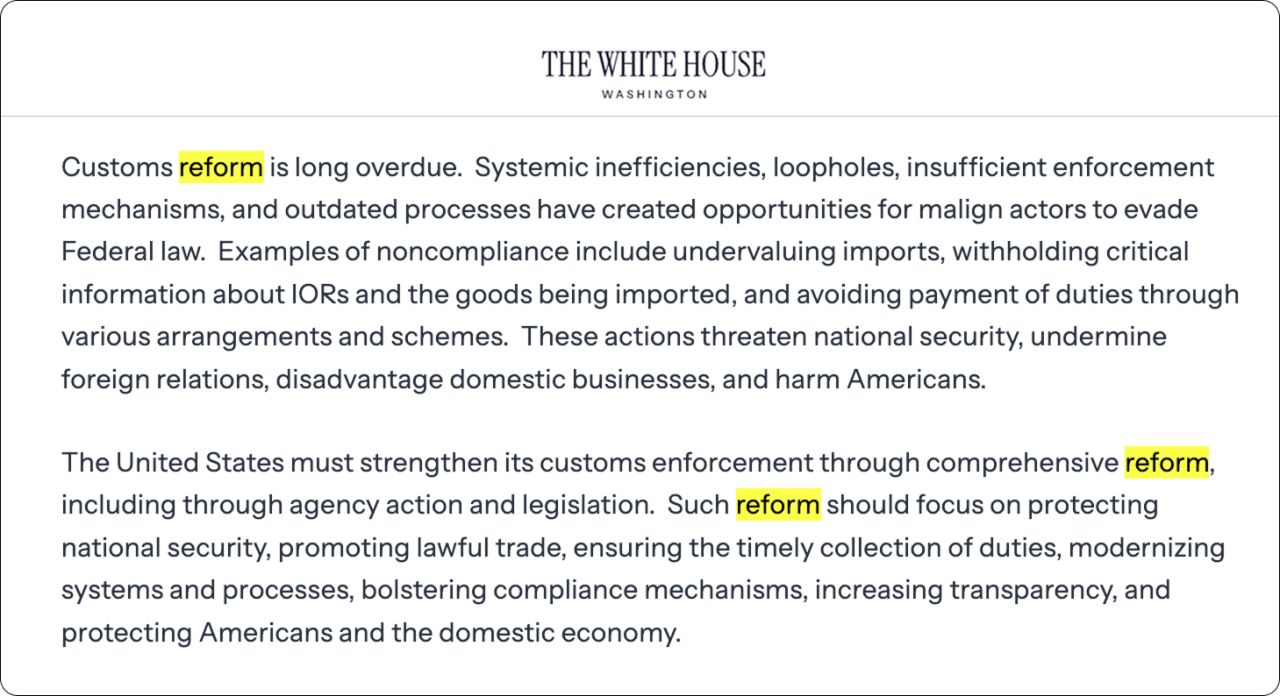
For businesses moving meaningful international trade volume through the United States, CTPAT can be one of the most valuable trusted trader programs available. That relevance has only increased with the June 2026 executive order on strengthening customs enforcement, which calls for tighter importer-of-record accountability, stronger vetting, and greater CTPAT participation for certain foreign importers and customs brokers. Fewer inspections, faster processing, and more predictable cargo movement can have a direct operational impact, especially for teams managing high-volume import activity or time-sensitive freight.
This guide covers what CTPAT is, who can apply, what CBP looks for, how the application process works, and where companies most often run into trouble.
Key Takeaways
- CTPAT is a voluntary CBP program for companies that maintain strong supply chain security practices.
- Certified members may benefit from fewer inspections, faster customs processing, and improved supply chain predictability.
- Eligibility includes importers, licensed customs brokers, freight forwarders, NVOCCs, carriers, foreign manufacturers, consolidators, and certain 3PLs.
- The Security Profile is usually the most time-consuming and important part of the application.
- CBP validates members after initial certification and typically revalidates every three to four years.
- Maintaining certification requires annual profile updates, internal reviews, documentation discipline, and timely responses to CBP.
What Is CTPAT?
CTPAT, or Customs-Trade Partnership Against Terrorism, is a voluntary partnership between US Customs and Border Protection (CBP) and the international trade community. CBP launched it after the September 11 attacks to strengthen supply chain security. Certified members that meet CBP's security standards receive reduced inspection rates, faster processing at borders, and a CBP Supply Chain Security Specialist as a point of contact. CTPAT also fits within the broader trusted trader model promoted by the World Customs Organization’s SAFE Framework.
For most members, CTPAT functions less like a customs program and more like an operating framework. It covers security across facilities, employees, systems, cargo, documentation, and business partners, with members maintaining written procedures, training staff, vetting partners, and responding quickly when CBP reaches out. Companies that do well with it build these practices into daily operations.
CTPAT also has mutual recognition arrangements with comparable programs in the EU, Canada, Mexico, Japan, Korea, and Singapore. Members shipping through those customs administrations get partial benefits at their borders too.
The operational payoff is fewer inspections, fewer holds, lower storage and demurrage costs, and more predictability for the planning teams that absorb the cost of every delay.
Who Can Apply for CTPAT?
CTPAT eligibility depends on the role a company plays in the international supply chain. The program is not limited to importers. Several types of trade participants can qualify, though each category has its own requirements and Security Profile.
Eligible categories include:
- U.S. importers
- Licensed U.S. customs brokers
- U.S.-based freight forwarders, NVOCCs, and consolidators
- Highway carriers operating in the United States, Canada, and Mexico
- Air, sea, and rail carriers
- Marine port authorities and terminal operators
- Foreign manufacturers in eligible countries
- Certain third-party logistics providers
The category matters. CBP does not evaluate every applicant the same way.
An importer will be assessed differently from a customs broker. A carrier will be assessed differently from a foreign manufacturer. A freight forwarder or NVOCC needs to apply under the category that reflects its role in the shipment lifecycle.
Before starting the application, companies should confirm which category fits their business, what Security Profile applies, and what documentation CBP will expect to see during validation.
What Are the CTPAT Security Requirements?
CTPAT security requirements live in CBP's Minimum Security Criteria (MSC), which defines what members must document, implement, and maintain to stay in the program.
The MSC covers corporate risk assessment, business partner controls, cybersecurity, seal security, procedural security, agricultural security, physical access controls, personnel security, facility security, security training, and information technology security. Criteria vary by business type, so an importer, a carrier, a customs broker, and a foreign manufacturer each complete a different Security Profile.
Two areas typically demand more work than teams expect.
Cybersecurity is the first. CBP expects documented IT security policies, controlled user access, employee training, and incident response procedures. For many companies, this is where informal practices and gaps in documentation become impossible to hide.
Business partner security is the second. Members assess and document the security practices of relevant suppliers, carriers, brokers, warehouses, and other parties in the chain. Partner information tends to live in email threads, spreadsheets, shared drives, and disconnected systems, which makes the documentation harder to pull together than people expect.
Across all of it, the common mistake is treating the MSC like a checklist. CBP wants written answers in the portal, but it also wants evidence that the practices show up in daily operations.
How Does the CTPAT Application Process Work?
The CTPAT application process is simple on paper. The work behind it is where most companies spend their time.
- Register in the CTPAT Portal.
The company submits basic company information. This includes business details, a program point of contact, and the membership category the company is applying under. - Complete the Security Profile.
This is the core of the application. The Security Profile explains how the company meets each applicable Minimum Security Criteria requirement. It should reflect actual procedures, training practices, documentation habits, audit processes, and the way the company manages security day to day.
Before starting the Security Profile, most companies gather security policies, training records, visitor management procedures, business partner verification documentation, cybersecurity policies, incident response procedures, and internal audit records. Applicants that prepare this documentation early generally move faster. - Submit the profile for CBP review.
CBP reviews the submitted Security Profile. If the profile meets program standards, CBP may certify the company. Certification is an important milestone, but it is not the end of the process. - Prepare for validation.
During validation, a CBP Supply Chain Security Specialist reviews whether the practices described in the Security Profile are actually in place. This may include visits to company facilities and, in some cases, supply chain partner facilities.
This is where weak applications tend to show. A polished Security Profile is not enough if the company cannot prove that the documented procedures are being followed. After validation, the company may move into a higher benefit tier. CBP then revalidates members every three to four years.
What Are the Benefits of CTPAT Certification?
The core benefit of CTPAT is recognition. Once certified, CBP treats the member as a lower-risk participant in international trade, and the operational consequences flow from there.
Common benefits include reduced examination rates, faster processing at borders, access to a CBP Supply Chain Security Specialist, eligibility for FAST lane processing at US/Canada and US/Mexico land crossings, and the marketing value of being a publicly listed CTPAT partner.
For high-volume importers, predictability is the real prize. Fewer inspections mean fewer delays, fewer demurrage and detention charges, and inventory planning that does not have to absorb random multi-day holds.
The benefit looks different by role. Customs brokers gain credibility with importer clients who expect a broker that understands trusted trader expectations. Freight forwarders and NVOCCs use certification to demonstrate stronger operating practices across documentation, partner management, cargo handling, and shipment coordination.
Benefits scale by tier as well. Certified (Tier 1) members are accepted on the basis of their Security Profile. Validated (Tier 2) members have been verified on-site by CBP. Validated with Recognized Best Practices (Tier 3) is reserved for companies whose security programs go meaningfully beyond MSC.
CTPAT reduces risk and improves predictability. It does not guarantee cargo will never be inspected. The benefits compound for companies that maintain the program well.
Common Mistakes Companies Make When Applying for CTPAT
Most CTPAT issues come from weak documentation, inconsistent procedures, or treating the application as a writing exercise instead of an operational program.
- Describing an ideal process instead of the real operation.
CBP validation is designed to test whether documented procedures are being followed in practice. If the profile says employees receive security training, the company should be able to produce training records. If the profile says visitors are controlled, the company should be able to show visitor logs, badge procedures, or access controls. - Underestimating business partner documentation.
CTPAT requires members to understand and document the security practices of relevant partners. Companies that wait until late in the process to gather this information often slow down their own application. - Weak personnel security documentation.
Hiring procedures, background screening, ID issuance, termination processes, and visitor controls all need to be documented and consistently applied. - Poor cybersecurity documentation.
Many companies have practical IT controls in place but lack written policies, access records, training documentation, or incident response plans. CBP has placed greater emphasis on cybersecurity, and applicants should expect this area to receive attention during review and validation. - Failing to maintain the program after certification.
Getting approved is only the beginning. Members need to update their Security Profile annually, respond to CBP communications, maintain supporting documentation, and prepare for revalidation.
The strongest applicants can show that their security practices are real, current, and consistently followed.
How to Maintain CTPAT Certification After Approval
Maintaining CTPAT certification requires ongoing work. Members must keep their Security Profile updated, respond to CBP requests, maintain internal procedures, and prepare for periodic revalidation.
At a minimum, members should update their Security Profile annually and whenever there are significant changes to operations, ownership, facilities, systems, or supply chain structure. Changes that affect security should not wait until the next review cycle.
Companies should also conduct internal reviews of their Minimum Security Criteria compliance. These reviews help identify documentation gaps, training issues, partner verification problems, or process changes before CBP identifies them during revalidation.
Ongoing documentation matters. Members should maintain records related to security training, visitor logs, employee screening, incident response, business partner verification, corrective actions, and internal audits.
CBP can suspend or remove certification if a member fails to maintain program requirements, does not respond to communications, experiences a serious security incident, or fails revalidation. Reinstatement usually requires corrective action and further CBP review.
Companies that retain CTPAT benefits over time tend to make the program part of their operating rhythm. They assign ownership, keep documentation current, train employees regularly, and treat revalidation as an expected part of the process.
Summary
CTPAT certification offers meaningful trade benefits in exchange for a real security commitment. For companies that already maintain strong supply chain security practices, certification often formalizes existing processes while unlocking faster customs processing, fewer inspections, and greater supply chain predictability.
For organizations building those processes for the first time, certification becomes a longer operational project. Done well, it can improve security, compliance, and risk management across the business.
The practical implications are clear. Companies should plan for Security Profile preparation, treat the Minimum Security Criteria as an operating model, document business partner security practices early, pay close attention to cybersecurity and personnel security, and plan for ongoing maintenance after certification.
For importers, customs brokers, and freight forwarders handling meaningful international trade volume, CTPAT remains one of the most valuable supply chain certifications available.
Frequently Asked Questions
Does CTPAT Reduce Customs Inspections?
Yes. One of the primary benefits of CTPAT membership is reduced examination rates for cargo and customs entries. Certification does not eliminate inspections, but CTPAT members are generally considered lower risk by CBP.
How Long Does It Take to Get CTPAT Certified?
Timing depends on how prepared the company is before applying. CBP’s review target for a submitted Security Profile is generally around 90 days, but preparing the profile itself can take several weeks or several months depending on operational complexity. Validation typically occurs after initial certification.
What Is the Most Difficult Part of the CTPAT Application?
For most companies, the Security Profile is the most difficult and time-consuming part of the process. It requires detailed documentation of security procedures, training programs, business partner controls, cybersecurity practices, and daily operating processes.
Who Is Eligible to Apply for CTPAT?
Eligible categories include U.S. importers, licensed U.S. customs brokers, U.S.-based freight forwarders and NVOCCs, carriers, consolidators, port and terminal operators, foreign manufacturers in eligible countries, and certain 3PLs.
Can You Lose CTPAT Certification?
Yes. CBP can suspend or remove certification if a member fails to maintain Minimum Security Criteria compliance, does not respond to CBP communications, experiences a serious security incident, or fails revalidation. Reinstatement generally requires corrective action and further review.
Reform helps freight forwarders, customs brokers, shippers, and carriers automate critical workflows without replacing the systems they already rely on. From quoting and booking to documentation and shipment operations, Reform reduces manual overhead, improves response times, and helps teams scale with less complexity.